Source from Plastics News
At K, Chen Hsong Holdings Ltd. was showing an upgraded version of its flagship MK6 line, a new MK6.6 Euroseries model, and Speed-Pack II 400 presses.
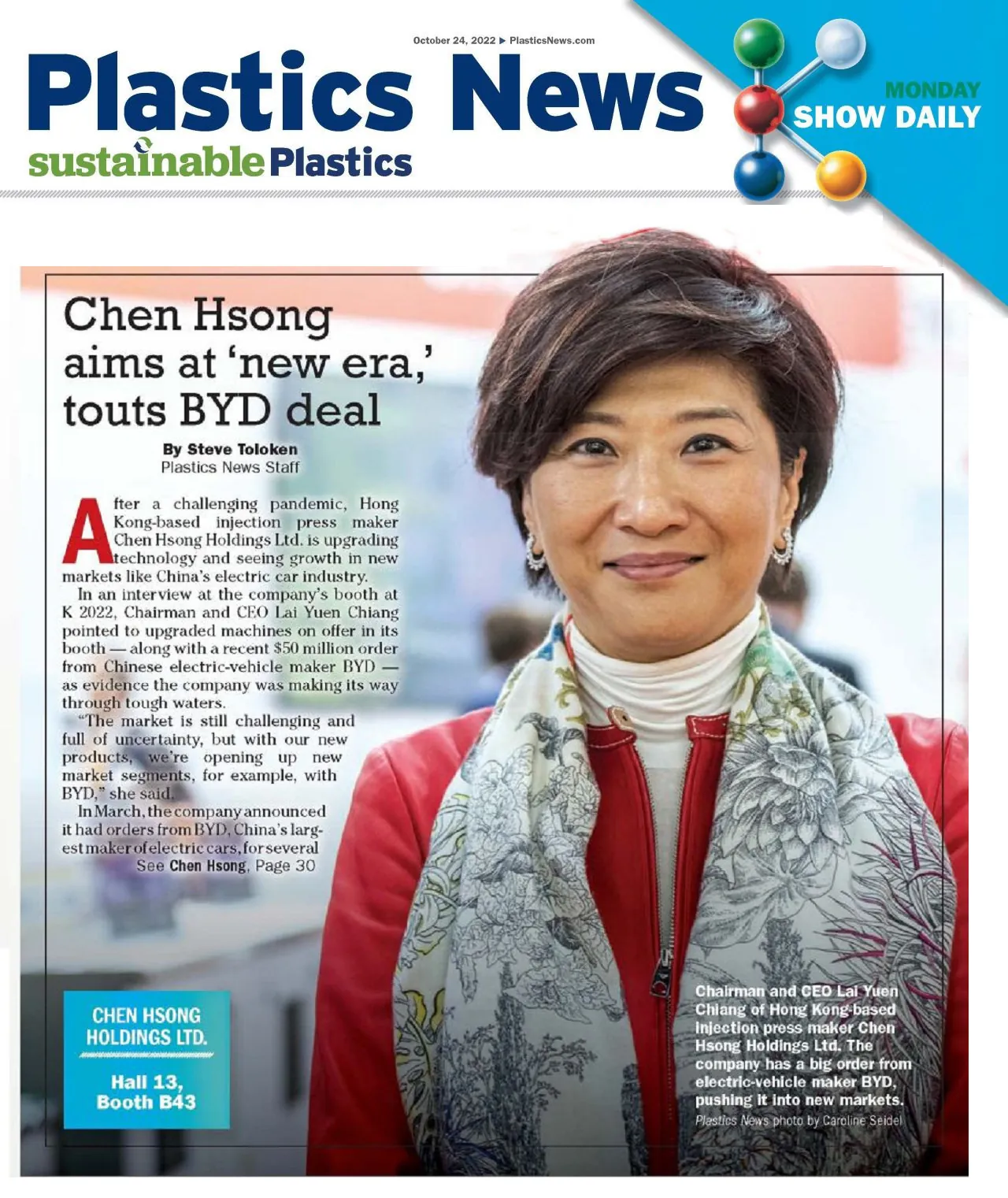
After a challenging pandemic, Hong Kong-based injection press maker Chen Hsong Holdings Ltd. is upgrading technology and seeing growth in new markets like China’s electric car industry.
In an interview at the company’s booth at K 2022, Chairman and CEO Lai Yuen Chiang pointed to upgraded machines on offer in its booth — along with a recent $50 million order from Chinese electric-vehicle maker BYD — as evidence the company was making its way through tough waters.
“The market is still challenging and full of uncertainty, but with our new products, we’re opening up new market segments, for example, with BYD,” she said.
In March, the company announced it had orders from BYD, China’s largest maker of electric cars, for several hundred injection presses, worth up to 350 million Chinese yuan ($48.3 million).
“That order is very important because it shows that we are fulfilling the requirements of the auto industry,” said Chiang.
BYD has been expanding globally. The carmaker is 19 percent owned by Warren Buffett’s Berkshire Hathaway and said its third-quarter profits likely more than tripled amid market growth, Reuters reported Oct. 18.
Chen Hsong said BYD is buying both its two-platen machines and its MK6 series.
The injection press maker, which is publicly traded on the Hong Kong Stock Exchange, said it sells more than 20,000 machines a year. In its last fiscal year ending March 31, it reported sales of HK$2.72 billion (US$347.5 million).
At K, it was showing an upgraded version of its flagship MK6 line, a new MK6.6 Euroseries model with easier-to-use interfaces, including a control unit from Austrian firm B&R Industrial Automation GmbH. It was molding a polypropylene lunchbox on a 15-second cycle time.
“What we did is we optimized the machine design,” said Chiang. “We hear what the customer needs. The most important feature we changed on the MK6.6 is the user interface experience.”
As well, the company was exhibiting one of its Speed-Pack II 400 presses, with integrated robots and in-mold labeling systems, designed for precision, thin-walled products.
It shaves one second off the cycle time of the model it replaces, giving it a cycle time of 5.6 seconds for an eight-cavity polypropylene cup mold.
Dave Fung, senior assistant to the chairman, said the Speed Pack II was developed to complement the MK6 and 6.6 models, which are aimed more at general applications.
The new machines are part of the company’s strategy to adapt to a changing economy in China, where newer applications like smart appliances and electric vehicles are doing well. China accounts for nearly 80 percent of its sales, Chiang said.
“I think only certain industries are booming,” she said. “The electric car industry is booming. Smart devices are also doing well. But more traditional industry is facing a bit of a slowdown. That’s why the message is mixed.”
In the company’s last financial report to the Hong Kong Stock Exchange in June, it cataloged both broad economic challenges and more immediate problems, like managing its operation through citywide coronavirus lockdowns that continued this year in Shenzhen, China, where it has its flagship factory.
In its business, Chiang said some older, established markets for its molding machines, like household electronics and toys makers, have not been faring as well.
It reported profits before taxes for the year were down 12 percent, as the economy slowed later in the year. But the company is pushing into new segments.
“We are penetrating the new-era industries,” Chiang said.